This article is about the Christian religious ceremony and other water-related religious practices. For other uses, see
Baptism (disambiguation).
In
Christianity,
baptism (from Greek βαπτίζω
baptizo: "immersing", "performing
ablutions", i.e., ritual washing)
[2] is for the majority the
rite of admission, almost invariably with the use of water, into the
Christian Church generally
[3] and also membership of a particular church tradition. Baptism has been called a
sacrament and an
ordinance of Jesus Christ.
The New Testament reports that Jesus himself was baptized.
[4] The usual form of baptism among
the earliest Christians was for the candidate to be immersed totally or partially.
[5][6][7][8][9] While
John the Baptist's use of a deep river for his baptism suggests immersion,
[10] pictorial and archaeological evidence of Christian baptism from the 3rd century onward indicates that the normal form was to have the candidate stand in water while water was poured over the upper body.
[11][12][13][14] Other common forms of baptism now in use include pouring water three times on the forehead.
Martyrdom was identified early in Church history as "baptism by blood", enabling martyrs who had not been baptized by water to be saved. Later, the Catholic Church identified a
baptism of desire, by which those preparing for baptism who die before actually receiving the
sacrament are considered saved.
[15] As evidenced also in the common Christian practice of
infant baptism, baptism was universally seen by Christians as in some sense necessary for
salvation, until
Huldrych Zwingli in the 16th century denied its necessity.
[16]
Today, some Christians, particularly
Quakers and the
Salvation Army, do not see baptism as necessary, and do not practice the rite. Among those that do, differences can be found in the manner and mode of baptizing and in the understanding of the significance of the rite. Most Christians baptize "in the name of the
Father, and of the
Son, and of the
Holy Spirit" (following the
Great Commission), but some baptize in
Jesus' name only. Most Christians
baptize infants;
[17] many others hold that only
believer’s baptism is true baptism. Some insist on submersion or at least partial immersion of the person who is baptized, others consider that any form of washing by water, as long as the water flows on the head, is sufficient.
"Baptism" has also been used to refer to any ceremony, trial, or experience by which a person is initiated, purified, or given a name.
[18] See
Other initiation ceremonies below.
Etymology
The English word "baptism" is derived indirectly through Latin from the Greek words "βαπτισμός" or "βάπτισμα", verbal nouns derived from "βαπτίζω". This in turn is traced to a reconstructed
Indo-European root *
gwabh-[19] or *
gwebh-[20][21] in the suffixed zero-grade form *
gwəbh-yo-[20] The Greek words are used in a great variety of meanings.
[22]
New Testament meaning of the word
As Christians of different traditions dispute whether total
immersion (submersion) is necessary for baptism, the precise meaning of the Greek word in the New Testament has become important for discussion.
The
Greek-English Lexicon of Liddell and Scott gives the primary meaning of the word
βαπτίζω (transliterated as "baptizô"), from which the English word "baptism" is derived, as "dip, plunge", but indicates, giving
Luke 11:38 as an example, that another meaning is "perform ablutions".
[2]
Usual meaning of the verb βαπτίζω
Although the Greek word
βαπτίζω does not exclusively mean dip, plunge or immerse (at least partially), lexical sources note that this is the usual meaning of the word in both the
Septuagint[23][24][25] and the
New Testament.
[26] A related word,
βάπτω, is also used in the New Testament, with the senses "dip" or "dye",
[27][28][29][30] The dipping may be incomplete, as in dipping a morsel of bread in wine (
Ruth 2:14).
[31]

Representation of baptism in early Christian art.
Other meanings
Two passages in the
New Testament indicate that the word βαπτίζω, when applied to a person, did not always indicate submersion. The first is Luke 11:38
[32] which tells how a Pharisee, at whose house Jesus ate, "was astonished to see that he did not first wash (
ἐβαπτίσθη, aorist passive of
βαπτίζω—literally, "be baptized") before dinner." This is the passage that Liddell and Scott cites as an instance of the use of
βαπτίζω to mean
perform ablutions. Jesus' omission of this action is similar to that of his disciples: "Then came to Jesus scribes and Pharisees, which were of Jerusalem, saying, Why do thy disciples transgress the tradition of the elders? for they wash (
νίπτω) not their hands when they eat bread."
[Mt 15:1-2] The other New Testament passage pointed to is: "The Pharisees…do not eat unless they wash (νίπτω, the ordinary word for washing) their hands thoroughly, observing the tradition of the elders; and when they come from the market place, they do not eat unless they wash themselves (literally, "baptize themselves"—βαπτίσωνται, passive or middle voice of βαπτίζω)".[Mk 7:3–4]
Scholars of various denominations
[33][34][35] claim that these two passages show that invited guests, or people returning from market, would not be expected to immerse themselves ("baptize themselves") totally in water but only to practise the partial immersion of dipping their hands in water or to pour water over them, as is the only form admitted by present Jewish custom.
[36]
The lexicographical works of Zodhiates and Balz & Schneider also say that in the second of these two cases,
Mark 7:4, the word βαπτίζω means that, after coming from the market, the Pharisees only immersed their hands in collected water, and so did not immerse themselves totally.
[37] They understand the meaning of βαπτίζω to be the same as βάπτω, to dip or immerse,
[38][39][40] a word used of the partial dipping of a morsel held in the hand into wine or of a finger into spilled blood.
[41]
Derived nouns
Two nouns derived from βαπτίζω appear in the New Testament: βαπτισμός and βάπτισμα. Βαπτισμός refers in
Mark 7:4 to a water-rite for the purpose of purification, washing, cleansing, of dishes;
[42][43] in the same verse and in
Hebrews 9:10 to Levitical cleansings of vessels or of the body;
[44] and in
Hebrews 6:2 perhaps also to baptism, though there it may possibly refer to washing an inanimate object.
[43] In
Colossians 2:12, inferior manuscripts have βάπτισμα, but the best have βαπτισμός, and this is the reading given in modern critical editions of the New Testament.
[45] This is the only New Testament instance in which βαπτισμός is clearly used of Christian baptism, rather than of a generic washing, but
Hebrews 6:2 may also refer to baptism.
[43] When referring merely to the cleansing of instruments, βαπτισμός is equated with ῥαντισμός (sprinkling), found only in
Hebrews 12:24 and
1Peter 1:2, a word used to indicate the symbolic cleansing by the Old Testament priest.
[46]
Βάπτισμα, which must not be confused with βαπτισμός,
[46] is found only in writings by Christians.
[42] In the New Testament, it appears at least 21 times:
- 13 times with regard to the rite practised by John the Baptist;[47]
- 3 times with reference to the specific Christian rite[48] (4 times if the use in some inferior manuscripts in Colossians 2:12 is counted);
- 5 times in a metaphorical sense.[49]
History
Baptism has been part of Christianity from the start, as shown by the many mentions in the
Acts of the Apostles and the
Pauline epistles. Christians consider Jesus to have instituted the sacrament of baptism. How explicit Jesus' intentions were and whether he envisioned a continuing, organized Church is a matter of dispute among scholars.
[16]
Background in Jewish ritual
Although the term "baptism" is not used to describe the Jewish rituals, the purification rites (or
mikvah—ritual immersion) in
Jewish laws and tradition have some similarity to baptism, and the two have been linked
[50] In the
Jewish Bible and other Jewish texts, immersion in water for ritual purification was established for restoration to a condition of "ritual purity" in specific circumstances. For example,
Jews who (according to the
Law of Moses) became ritually defiled by contact with a corpse had to use the
mikvah before being allowed to participate in the Holy Temple. Immersion is required for
converts to Judaism as part of their conversion. Immersion in the mikvah represents a change in status in regards to purification, restoration, and qualification for full religious participation in the life of the community, ensuring that the cleansed person will not impose uncleanness on property or its owners
Num. 19 and
Babylonian Talmud,
Tractate Chagigah, p. 12). This change of status by the mikvah could be obtained repeatedly, while Christian baptism, like
circumcision, is, in the general view of Christians, unique and not repeatable.
[51] (Seventh-day Adventists, however, see baptism as repeatable if a believer comes to a new knowledge of Christianity, as in
Acts 19:1-5. They teach that it is also possible for a person who has fallen away from following Christ to make a new commitment via rebaptism.)
[52]
John the Baptist adopted baptismal immersion as the central sacrament in his messianic movement.
[53]
Baptism of Jesus
John the Baptist was a 1st-century mission preacher on the banks of the River Jordan.
[54] According to
Christian theology, he was selected by God to proclaim the first coming of the Christ. He baptized Jews for repentance in the River Jordan.
[55]
At the start of his ministry,
Jesus was baptized by John the Baptist. Many of the earliest followers of Jesus were other people who, like him, were baptized in the Jordan by John the Baptist.
[56]
Critical scholars broadly agree that the baptism of Jesus is one of the most authentic, or historically likely, events in the life of the
historical Jesus. Jesus and his earliest disciples accepted the validity of John's baptism, though Jesus himself detached the notion of repentance from baptism and promoted purity ethic in tension with rituals.
[57] Early Christianity practiced a baptism of repentance which conferred the remission of sins. Christian baptism has its origin in the baptism of Jesus, in both a direct and historical sense.
[58]
John's baptism signified repentance in preparation for submission to Christ, and potentially made one a disciple of John. As Jesus had nothing to repent of, and was greater than John, his baptism seems contradictory to the Christian belief in the sinless Divine nature of Jesus Christ. However, Matthew,
[Mt 3:14-15] writing to a Jewish audience, records the protest of John on this account and informs that Jesus did so in order to "fulfill all righteousness." This has been understood by Christian commentators as teaching that as the incarnate Son of God was obedient to parents, and had submitted to circumcision - that being the commanded initiatory ordinance of the Mosaic dispensation - it was also necessary that he should submit to John's baptism. And that this was also due to Jesus spiritually representing the high priest, whom the law required was to be ceremonially initiated into his office by washing and anointing.[Lv 8:1-6][59]
In the gospel of Mark, the baptism by John is the setting for the
theophany, the revelation of Jesus' divine identity as the
Son of God,
[Mk 1:7-11] which is also seen in the Matthew account.[Mt 3:17] Luke emphasizes the subservience of John to Jesus while both are still in the womb.[Lk 1:32-45] [3:18-21] The Gospel of John omits the episode.[60]
Early explanations for Jesus' baptism that have remained popular include
Ignatius of Antioch's assertion that Jesus was baptized to purify the waters of baptism and
Justin Martyr's explanation that Jesus was baptized in his role as the ideal example for everyone.
[60]
Baptism by Jesus
The
Gospel of John[Jn 3:22-30] [4:1-4] states that Jesus at an early stage led a mission of baptism that drew crowds. John 4:2, considered by many scholars to be a later editorial insertion,[61] denies that Jesus himself baptized and states that he did so only through his disciples.
Some prominent scholars conclude that Jesus did not baptize.
Gerd Theissen and
Annette Merz assert that Jesus did not baptize, detached the notion of repentance from baptism, recognized John's baptism, and put forward a purity ethic in tension with baptism.
[57] The
Oxford Dictionary of World Religions also states that Jesus did not baptize as part of his ministry.
[14][page needed]
E. P. Sanders omits John's account of Jesus' baptizing mission from his portrait of Jesus as a historical figure.
[62]
Robert W. Funk considers the account of Jesus' baptism ministry in John to have internal difficulties: that, for instance, it reports Jesus coming to Judea even though he is already in Jerusalem and thus in Judea.
[63] John 3:22 actually speaks of Jesus and his disciples coming, not "εἰς τὴν Ἰουδαίαν" (into Judea), but "εἰς τὴν Ἰουδαίαν γῆν" (into the Judean countryside),
[64] which some interpret as contrasted with Jerusalem, the scene of the encounter with Nicodemus described immediately before.
[65] According to the Jesus Seminar, the passage about Jesus "coming to Judea" (as they interpret "εἰς τὴν Ἰουδαίαν γῆν") to lead a mission of baptism probably preserves no historical information (a "black" rating).
[63]
On the other hand, the Cambridge Companion to Jesus
[66] takes a different view. According to this source, Jesus accepted and made his own John the Baptist's message of repentance, forgiveness and baptism;
[67] taking over from John, when the latter was imprisoned, he called for repentance and for baptism as a first step in accepting the imminent kingdom of God;
[68] and the central place of baptism in his message is confirmed by the passage in John about Jesus baptizing.
[69] After John's execution, Jesus ceased baptizing, through he may have occasionally returned to the practice; accordingly, while baptism played an important part in Jesus' ministry before John's death and again among his followers after his resurrection, it had no such prominence in between.
[70]
New Testament scholar
Raymond E. Brown, a specialist in the Johannine writings, considers that the parenthetic editorial remark of
John 4:2 that Jesus baptized only through his disciples was intended to clarify or correct the twice repeated statement in the preceding verses that Jesus did baptize, and that the reason for its insertion may have been that the author considered the baptism that the disciples administered to be a continuation of the Baptist's work, not baptism in the Holy Spirit.
[71]
Other New Testament scholars also accept the historical value of this passage in John. This is the view expressed by
Joel B. Green,
Scot McKnight,
I. Howard Marshall.
[72] Another states that there is "no
a priori reason to reject the report of Jesus and his disciples' conducting a ministry of baptism for a time", and mentions that report as one of the items in John's account
[3:22-26] "that are likely to be historical and ought to be given due weight".[73]
In his book on the relationship between John the Baptist and Jesus of Nazareth,
Daniel S. Dapaah says that John's account "may be a snippet of historical tradition", and comments that the silence of the Synoptic Gospels does not mean that the information in John was invented, and that Mark's account also suggests that Jesus worked with John at first, before moving to Galilee.
[74] Frederick J. Cwiekowski agrees that the account in John "gives the impression" that Jesus baptized.
[75]
The
Joseph Smith Translation of the Bible says that "though
he [Christ] himself baptized not
so many as his disciples; 'For he suffered them for an example, preferring one another.'
[76]
The Gospel of John remarks, in
John 3:32, that, though Jesus drew many people to his baptism, they still did not accept his testimony,
[77] and the
Jesus Seminar concludes, on the basis of Josephus's accounts, that John the Baptist likely had a larger presence in the public mind than Jesus.
[55]
New Testament
The
New Testament includes several references to baptism as an important practice among early Christians and, while giving no actual account of its institution by Jesus, portrays him as giving instructions, after his
resurrection, for his followers to perform the rite (see
Great Commission).
[78] It also gives interpretations by the
Apostle Paul and in the
First Epistle of Peter of the significance of baptism.
- "Truly, truly, I say to you, unless one is born of water and the Spirit, he cannot enter the kingdom of God" John 3:5 RSV
- "Christ loved the church and gave himself up for her, that he might sanctify her by the washing of water with the word, that he might present the church to himself in splendor, without spot or wrinkle or any such thing, that she might be holy and without blemish." Ephesians 5:25-27 RSV
- "God's patience waited in the days of Noah, during the building of the ark, in which a few, that is, eight persons, were saved through water. Baptism, which corresponds to this, now saves you" 1 Peter 3:20-21 RSV
Baptism
signifies: [Romans 4:11-12] [Colossians 2:11-12] [79]
Paul's epistles
The Apostle Paul wrote several influential letters in the AD 50s, later accepted as canonical. For Paul, baptism
effects and represents the believer's union with Christ, a union by which the believer shares in Christ's death and resurrection;
[Rom 6:3-4] cleanses of sin;[1 Cor 6:11] incorporates into the Body of Christ and makes one "drink of the Spirit."[1 Cor 12:13][16] See Ex opere operato.
The conception of a sacramental principle, widespread not only in the Greco-Roman world, but even in pre-Columbian America and in preliterate societies, took on a unique significance, and to Paul's influence is attributed an interpretation given to the Christian rite in terms of the
Greco-Roman mysteries.
[80] but little weight can be attached to the counterparts of baptism in mystery religions as an explanation of the Christian practice.
[16]
Gospel of Matthew
- Matthew 3:11-17; Matthew 28:18-20
Matthew
[81] begins with the "generation" of Jesus as Son of David, followed by the visit of the gentile
Magi, and the
flight into Egypt to escape
Herod, after whose death the
holy family returns into the
land of Israel, then moves to
Nazareth, and then includes a detailed version of the preaching of John the Baptist, followed by the baptism of Jesus.
[Mt 3:11-15] John protests to Jesus that he needs to be baptized by Jesus, but Jesus tells him to let it be so now, saying that it is fitting for the two of them ("for us") to thus "fulfill all righteousness." When Jesus is baptized, he goes up immediately out of the water, the heavens open and John sees the Spirit of God descend upon him like a dove, alighting on him, and he hears a voice from heaven say, "This is my beloved Son, with whom I am well pleased."
Later, at the request of the mother of James and John, who prompted her to present their request to him to declare that they are to sit one at his right hand and the other at his left, Jesus speaks of the "cup" he is to drink
[20:20-23], and he tells them that they too will drink of his cup, but in Matthew's gospel Jesus does not explicitly state that the baptism with which he must be baptized is also the "cup" that he must drink.
The Gospel of Matthew also includes the most famous version of the Great Commission.
[28:18-20] Here, the resurrected Jesus appears to the apostles and commissions them to make disciples of all nations, to baptize, and teach.[82] This commission reflects the program adopted by the infant Christian movement.[82]
Gospel of Mark
- Mark 1:1-11
This gospel, today generally believed by scholars to be the first
[83] and to have been used as a basis for Matthew and Luke, begins with Jesus' baptism by John, who preached a baptism of repentance for forgiveness of sins. John says of Jesus that he will baptize not with water but
with the Holy Spirit. At Jesus' baptism, he hears God's voice proclaiming him to be his Son, and he sees the spirit like a dove descend on him
During Jesus' ministry, when James and John ask Jesus for seats of honor in the coming kingdom
[10:35-39], Jesus likens his fate to the cup that he will drink and to the baptism with which he must be baptized, the very cup and baptism in store for John and James (that is, martyrdom).[84]
- Mark 16:19-20
The
traditional ending of Mark is thought to have been compiled early in the 2nd century, and initially appended to the gospel by the middle of that century.
[85] It says that those who believe
and are baptized will be saved, "but he who does not believe will be condemned."
[Mk 16:9-20] Mark's gospel does not explicitly state that baptized persons who believe will be saved from the "wrath to come," the wrath to which John the Baptist refers in Matthew's gospel[3:7-10], but readers can infer that being "condemned" includes the "wrath to come".
Gospel of Luke
- Luke 3:21-22; Luke 24:45-47
This gospel begins with a statement that it contains reliable information obtained directly from the original eyewitnesses and servants of the word
[1:1-4]. It introduces the conception of John the Baptist, the annunciation of Gabriel to Mary the virgin, the birth of the Baptist who will be called the prophet of the Most High, and then the birth of Jesus, in the days of Herod, king of Judea, and of Caesar Augustus, emperor of the Roman Empire. There follows the account of Jesus in the Temple among the teachers; and then the calling and preaching of the prophet John the Baptist in the days of Tiberius Caesar, emperor, of Herod and Philip, tetrarchs, of Annas and Caiaphas, high priests; and then by far the briefest account in the canonical Gospels of the baptism of Jesus[3:1-22].
The baptism of John is
different from the baptism of the one who is to come after him
[3:3][3:16]. Jesus declares later that he has another baptism to be baptized with, and that he is under constraint (he is straitened) until it is accomplished[12:50]. (The petition of the mother of James and John, the personal request of James and John, and Jesus' declaration to them that they will be baptized as he will be baptized, and will drink the cup that he will drink, is not in Luke's gospel.)
In the Gospel of Luke, the risen Jesus appears to the disciples and the eleven apostles gathered together with them in Jerusalem and gives them the Great Commission
[24:45-47] without explicitly speaking of baptism, but readers can infer that "the forgiveness of sins" here includes "baptism" according to the preaching of the apostles at the time of Luke's gospel.
Acts
Acts of the Apostles, written
c. 85–90,
[86] states that about 3,000 people in Jerusalem were baptized in one day on
Pentecost.
[2:41] It further relates baptisms of men and women in Samaria,[8:12-13] of an Ethiopian eunuch,[8:36-40] of Saul of Tarsus,[9:18] [22:16] of the household of Cornelius,[10:47-48] of Lydia's household,[16:15] of the Philippi jailer's household,[16:33] of many Corinthians[18:8] and of certain Corinthians baptized by Paul personally.[1:14-16]
In Acts, the prerequisites of baptism are faith and repentance.
[16] Acts associates baptism with receiving the Spirit, but the exact connection is not always the same.
[16]
Also in Acts, some twelve men who had undergone John's baptism, a "baptism of repentance" that John administered, "telling the people to believe in the one who was to come after him, that is, Jesus", were baptized "in the name of the Lord Jesus", whereupon they received the Holy Spirit.
[19:1-7]
Acts 2:38,
Acts 10:48 and
Acts 19:5 speak of baptism "in the name of Jesus" or "in the name of the Lord Jesus Christ", but whether this was a formula that was used has been questioned.
[16]
Gospel of John
The
Gospel of John mentions John the Baptist's baptizing activity,
[1:24-28] [3:22-23] [10:40-41] in particular his baptism of Jesus,[1:15], and his statement that Jesus would baptize with the Holy Spirit.[1:29-34] It also mentions baptizing activity by Jesus,[3:25-30] specifying that the baptizing was not done by Jesus himself but by his disciples.[4:1-3]
Some references to water in John's Gospel have been interpreted as referring to baptism, in particular, the phrase "born of water and the Spirit"
[3:2-9] and the account of blood and water coming out of the side of Jesus when pierced after crucifixion[19:31-37][87]
Apostolic period
Main article:
Apostolic AgeThe Apostolic Age is the period from Jesus' life to the death of the last apostle c.
100 (see
Beloved Disciple). Most of the New Testament was written during this period, and the primary sacraments of baptism and the
Eucharist were established. Protestants in particular value the church of the Apostolic Age as a witness to Jesus' true message, which they believe was subsequently corrupted during the
Great Apostasy.
Along with fasting, the practice of baptism may have entered Christian practice under the influence of former followers of John's.
[55]
The
Didache or
Teaching of the Twelve Apostles, an anonymous book of 16 short chapters, is probably the earliest known written instructions, outside of the Bible, for administering baptism. The first edition was written c.
60–80 AD.
[88] The second, with insertions and additions, was written c.
100–150 AD.
[88] This work, rediscovered in the 19th century, provides a unique look at Christianity in the Apostolic Age. In particular, it describes the two foundational sacraments of Christianity: the Eucharist and baptism. It indicates a preference for baptizing by immersion in "living water" (i.e., running water seen as symbolic of life)
[89] or, if that is unavailable, in still water, preferably at its natural temperature, but considers that, when there is not enough water for immersion, it is sufficient to pour water on the head.
[90][91][92][93][94]
In Matthew's (c.
80–85[86])
Great Commission, Christians are to baptize in the name of the Father, and of the Son, and of the Holy Spirit.
[82] Baptism has been in the name of the Father, and of the Son, and of the Holy Spirit since at least the end of the 1st century.
[16] In Acts (c.
90),
[86] Christians baptize "in the name of Jesus"
[Ac 19:5] though whether that meant a spoken formula has been questioned.[16]
There is general agreement that the New Testament contains no positive evidence for infant baptism,
[95][96] and the requirements made by the Didache on baptismal candidates are typically understood as precluding infant baptism.
[97][98][99]
Early Christianity
Early Christian beliefs (Christianity practiced after the apostolic age) regarding baptism were variable.
[14] In the most usual form of early Christian baptism, the candidate stood in water and water was poured over the upper body.
[14] Baptism of the sick or dying usually used means other than even partial immersion and was still considered valid.
[100] The theology of baptism attained precision in the 3rd and 4th centuries.
[14]
While instruction was at first given after baptism, believers were given increasingly specific instructions before being baptized, especially in the face of heresies in the 4th century.
[101] By then, postponement of baptism had become general, and a large proportion of believers were merely
catechumens (
Constantine was not baptized until he was dying); but as baptisms of the children of Christians, using an adaptation of the rite intended for adults, became more common than baptisms of adult converts, the number of catechumens decreased.
[101]
As baptism was believed to forgive sins, the issue of sins committed after baptism arose. Some insisted that apostasy, even under threat of death, and other grievous sins cut one off forever from the Church. As indicated in the writings of Saint
Cyprian, others favoured readmitting the "
lapsi" easily. The rule that prevailed was that they were readmitted only after undergoing a period of penance that demonstrated sincere repentance.
What is now generally called the
Nicene Creed, longer than the text adopted by the
First Council of Nicaea of 325, and known also as the Niceno-Constantinopolitan Creed because of its adoption in that form by the
First Council of Constantinople in 381, was probably the baptismal creed then in use in Constantinople, the venue of the 381 Council.
[102]
Early Middle Ages
Infant baptism became common, alongside the developing theology of
original sin, displacing the earlier common practice of delaying baptism until the deathbed.
[14] Against Pelagius, Augustine insisted that baptism was necessary for salvation even for virtuous people and for children.
Middle Ages
The 12th century saw the meaning of the word "
sacrament" narrowed down and restricted to seven rites, among them that of baptism, while other symbolic rites came to be called "
sacramentals".
[103]
In the period between the 12th and the 14th centuries,
affusion became the usual manner of administering baptism in Western Europe, though immersion continued to be found in some places even as late as the 16th century.
[100] Throughout the Middle Ages, there was therefore considerable variation in the kind of facility required for baptism, from the baptismal pool large enough to immerse several adults simultaneously of the 13th century
Baptistery at Pisa, to the half-metre deep basin in the 6th century baptistery of the old
Cologne Cathedral.
[104]
Both East and West considered washing with water and the Trinitarian baptismal formula necessary for administering the rite.
Scholasticism referred to these two elements as the matter and the form of the sacrament, employing terms taken from the then prevailing
Aristotelian philosophy. The
Catechism of the Catholic Church, while teaching the necessity of both elements, nowhere uses these philosophical terms when speaking of any of the sacraments.
[105]
Reformation
In the 16th century,
Martin Luther considered baptism to be a sacrament. For the Lutherans, baptism is a "
means of grace" through which God creates and strengthens "saving faith" as the "washing of regeneration"
[Titus 3:5] in which infants and adults are reborn.[Jn 3:3-7] Since the creation of faith is exclusively God's work, it does not depend on the actions of the one baptized, whether infant or adult. Even though baptized infants cannot articulate that faith, Lutherans believe that it is present all the same.[106] Because it is faith alone that receives these divine gifts, Lutherans confess that baptism "works forgiveness of sins, delivers from death and the devil, and gives eternal salvation to all who believe this, as the words and promises of God declare."[107] In the special section on infant baptism in his Large Catechism, Luther argues that infant baptism is God-pleasing because persons so baptized were reborn and sanctified by the Holy Spirit.[108]
Swiss Reformer
Huldrych Zwingli differed with the Lutherans by denying sacramental status of baptism. Zwingli identified baptism and the Lord's supper as sacraments, but in the sense of an initiatory ceremony.
[16] His understanding of these sacraments as symbolic differentiated him from Luther.
Anabaptists (a word that means "rebaptizers") rejected so thoroughly the tradition maintained by Lutherans as well as Catholics that they denied the validity of baptism outside their group. They "rebaptized" converts on the grounds that one cannot be baptized without wishing it, and an infant, who does not understand what happens in a baptism ceremony and who has no knowledge of the concepts of Christianity, is not really baptized. They saw as non-biblical the baptism of infants, who cannot confess their faith and who, not having yet committed any sins, are not in the same need of salvation. Anabaptists and other Baptist groups do not consider that they
rebaptize those who have been baptized as infants, since, in their view, infant baptism is without effect. The
Amish, Restoration churches (
Churches of Christ/
Christian Church),
Hutterites,
Baptists,
Mennonites and other groups descend from this tradition.
Pentecostal,
charismatic and most non-denominational churches share this view as well.
[109]
Mode and manner
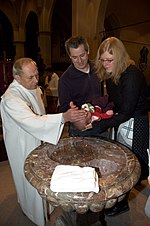
Baptism of a child by affusion
A Christian baptism is administered in one of the following forms, performing the action either once or thrice:
[110][111]
Aspersion
Aspersion is the sprinkling of water on the head.
Affusion

An affusion baptism, in the
Santa Cruz Parish, 1991.
Affusion is the pouring of water over the head.
Immersion
The word "immersion" is derived from
late Latin immersionem, a noun derived from the verb
immergere (
in- "into" +
mergere "dip"). In relation to baptism, some use it to refer to any form of dipping, whether the body is put completely under water or is only partly dipped in water; they thus speak of immersion as being either total or partial. Others, of the Anabaptist tradition, use "immersion" to mean exclusively plunging someone entirely under the surface of the water (submersion).
[112][113] The term "immersion" is also used of a form of baptism in which water is poured over someone standing in water, without submersion of the person.
[114][115] On these three meanings of the word "immersion", see
Immersion baptism.
When "immersion" is used in opposition to "submersion",
[116] it indicates the form of baptism in which the candidate stands or kneels in water and water is poured over the upper part of the body. Immersion in this sense has been employed in West and East since at least the 2nd century and is the form in which baptism is generally depicted in early Christian art. In the West, this method of baptism began to be replaced by
affusion baptism from around the 8th century, but it continues in use in
Eastern Christianity.
[114][115][117]
Submersion
The word Submersion comes from the
late Latin (
sub- "under, below" +
mergere "plunge, dip")
[118] and is also sometimes called "complete immersion". It is the form of baptism in which the water completely covers the candidate's body. Submersion is practiced in the Orthodox and several other Eastern Churches (although immersion, as distinct from submersion, is now also common), as well as in the
Ambrosian Rite. It is one of the methods provided in the
Roman Rite of the baptism of infants. The supposition that the term "immersion", used by historians when speaking of the usual practice of the early Christians,
[92][93] referred to submersion has been challenged from the evidence of primitive pictorial representations and from measurements of surviving early baptismal fonts.
[119] It is still frequently confused with
immersion.

An evangelical Protestant Baptism by submersion in a river
Baptists believe that "Christian baptism is the immersion of a believer in water. …It is an act of obedience symbolizing the believer's faith in a crucified, buried, and risen Saviour, the believer's death to sin, the burial of the old life, and the resurrection to walk in newness of life in Christ Jesus" [ellipsis retained from quoted text].
[120] Baptists, like most other Christians who believe in baptism by total immersion, read Biblical passages
[121] to imply that the practice intentionally symbolizes burial and resurrection. Especially when performed before onlookers, the total immersion ceremony depicts a burial (when the person being baptized is submerged under the water, as if buried), and a resurrection (when the person comes up out of the water, as if rising from the grave)—a "death" and a "burial" to an old way of life focused on sinning, and a "resurrection" to the start of a new life as a Christian focused on God. Such Christians typically believe that
John 3:3-5 also supports this view, with its implication that water baptism
symbolizes (but does not produce) a Christian being "born again" spiritually.
[122]
Baptism by submersion is also practiced by the
Christian Church (Disciples of Christ),
[123] although the faith does not suggest rebaptism of those who have undergone a different Christian baptism tradition.
[124] Baptism in
Churches of Christ, which also have roots in the
Restoration Movement, is performed only by bodily immersion.
[125]:p.107[126]:p.124 This is based on their understanding of the meaning of the word
baptizo as used in the New Testament, a belief that it more more closely conforms to the death, burial and resurrection of Jesus, and that historically immersion was the mode used in the 1st century, and that pouring and sprinkling later emerged as secondary modes when immersion was not possible.
[127][128]:p.139-140
Seventh-day Adventists believe that "Baptism symbolizes dying to self and coming alive in Jesus." They practice full immersion baptism.
[129]
Latter-day Saints beliefs concerning baptism state "You are briefly immersed in water, as Jesus Christ was baptized. Baptism by immersion is a sacred symbol of the death, burial, and Resurrection of Jesus Christ, and it represents the end of your old life and the beginning of a new life as a disciple of Jesus Christ."
[130] The
Community of Christ also practices submersion for their baptisms.
Jehovah's Witnesses teach "When a person is baptized, his whole body should be put under the water momentarily."
[131]
Apparel
Until the
Middle Ages, most baptisms were performed with the candidates completely naked—as is evidenced by most of the early portrayals of baptism (some of which are shown in this article), and the early Church Fathers and other Christian writers. Typical of these is Cyril of Jerusalem who wrote "On the Mysteries of Baptism" in the 4th Century (c. 350 A.D.):
Do you not know, that so many of us as were baptized into Jesus Christ, were baptized into His death? etc.…for you are not under the Law, but under grace.
1. Therefore, I shall necessarily lay before you the sequel of yesterday's Lecture, that you may learn of what those things, which were done by you in the inner chamber, were symbolic.
2. As soon, then, as you entered, you put off your tunic; and this was an image of putting off the old man with his deeds.[Col 3:9] Having stripped yourselves, you were naked; in this also imitating Christ, who was stripped naked on the Cross, and by His nakedness put off from Himself the principalities and powers, and openly triumphed over them on the tree. For since the adverse powers made their lair in your members, you may no longer wear that old garment; I do not at all mean this visible one, but the old man, which waxes corrupt in the lusts of deceit.[Eph 4:22] May the soul which has once put him off, never again put him on, but say with the Spouse of Christ in the Song of Songs, I have put off my garment, how shall I put it on?[Song of Sol 5:3] O wondrous thing! You were naked in the sight of all, and were not ashamed; for truly ye bore the likeness of the first-formed Adam, who was naked in the garden, and was not ashamed.
3. Then, when you were stripped, you were anointed with exorcised oil, from the very hairs of your head to your feet, and were made partakers of the good olive-tree, Jesus Christ.
4. After these things, you were led to the holy pool of Divine Baptism, as Christ was carried from the Cross to the Sepulchre which is before our eyes. And each of you was asked, whether he believed in the name of the Father, and of the Son, and of the Holy Ghost, and you made that saving confession, and descended three times into the water, and ascended again; here also hinting by a symbol at the three days burial of Christ.… And at the self-same moment you were both dying and being born;[132]
The symbolism is threefold:
1. Baptism is considered to be a form of rebirth—"by water and the Spirit"
[Jn 3:5]—the nakedness of baptism (the second birth) paralleled the condition of one's original birth. For example, St. John Chrysostom calls the baptism "λοχείαν", i.e., giving birth, and "new way of creation…from water and Spirit" ("to John" speech 25,2), and later elaborates:
-
"For nothing perceivable was handed over to us by Jesus; but with perceivable things, all of them however conceivable. This is also the way with the baptism; the gift of the water is done with a perceivable thing, but the things being conducted, i.e., the rebirth and renovation, are conceivable. For, if you were without a body, He would hand over these bodiless gifts as naked [gifts] to you. But because the soul is closely linked to the body, He hands over the perceivable ones to you with conceivable things " (Chrysostom to Matthew., speech 82, 4, c. 390 A.D.)
2. The removal of clothing represented the "image of putting off the old man with his deeds" (as per Cyril, above), so the stripping of the body before for baptism represented taking off the trappings of sinful self, so that the "new man," which is given by Jesus, can be put on.
3. As St. Cyril again asserts above, as Adam and Eve in scripture and tradition were naked, innocent and unashamed in the Garden of Eden, nakedness during baptism was seen as a renewal of that innocence and state of original sinlessness. Other parallels can also be drawn, such as between the exposed condition of Christ during His crucifixion, and the crucifixion of the "old man" of the repentant sinner in preparation for baptism.
Changing customs and concerns regarding modesty probably contributed to the practice of permitting or requiring the baptismal candidate to either retain their undergarments (as in many Renaissance paintings of baptism such as those by da Vinci, Tintoretto, Van Scorel, Masaccio, de Wit and others) and/or to wear, as is almost universally the practice today, baptismal robes. These robes are most often white, symbolizing purity. Some groups today allow any suitable clothes to be worn, such as trousers and a t-shirt—practical considerations include how easily the clothes will dry (denim is discouraged), and whether they will become see-through when wet.
Meaning and effects
There are differences in views about the effect of baptism for a Christian. Some Christian groups assert baptism is a requirement for salvation and a
sacrament, and speak of "
baptismal regeneration". Its importance may be understood by an informed knowledge of their interpretation of the most fundamental and basic meaning of the "Mystical Body of Christ" as found in the New Testament. This view is shared by the
Catholic and
Eastern Orthodox traditions, and by Churches formed early during the
Protestant Reformation such as
Lutheran and
Anglican. For example,
Martin Luther said:
To put it most simply, the power, effect, benefit, fruit, and purpose of Baptism is to save. No one is baptized in order to become a prince, but as the words say, to "be saved". To be saved, we know, is nothing else than to be delivered from sin, death, and the devil and to enter into the kingdom of Christ and live with him forever.
The
Churches of Christ and
The Church of Jesus Christ of Latter-day Saints also espouse baptism as necessary for salvation.
For Roman Catholics, baptism by water is a sacrament of initiation into the life of the children of God (
Catechism of the Catholic Church, 1212–13). It configures the person to Christ (CCC 1272), and obliges the Christian to share in the Church's apostolic and missionary activity (CCC 1270). The Catholic Tradition holds that there are three types of baptism by which one can be saved: sacramental baptism (with water), baptism of desire (explicit or implicit desire to be part of the Church founded by Jesus Christ), and baptism of blood (
martyrdom).
Pope Pius XII, in his encyclical
The Mystical Body of Christ, June 29, 1943, includes
all baptized Christians as members of Christ, members of the one true Church, which is the body of Jesus Christ himself, as God the Holy Spirit has taught through the Apostle Paul.
(Mystici Corporis Christi–full text) (
the bold emphasis provided here is not in the encyclical)
- 18...Through the waters of Baptism those who are born into this world dead in sin are not only born again and made members of the Church, but being stamped with a spiritual seal they become able and fit to receive the other Sacraments.
- 27...He also determined that through Baptism those who should believe would be incorporated in the Body of the Church.
- 30...it was on the tree of the Cross, finally, that He entered into possession of His Church, that is, of all the members of His Mystical Body; for they would not have been united to this Mystical Body through the waters of Baptism except by the salutary virtue of the Cross, by which they had been already brought under the complete sway of Christ.
- 34 That this Mystical Body which is the Church should be called Christ's is proved in the second place from the fact that He must be universally acknowledged as its actual Head. "He," as St. Paul says, "is the Head of the Body, the Church." (Col. 1:18)
– Mystici Corporis Christi
By contrast, most
Reformed (
Calvinist),
evangelical, and
fundamentalist Protestant groups recognize baptism as an act of obedience to and identification with Jesus as the Christ. They say that baptism has no sacramental (saving) power, and only
testifies outwardly to the invisible and internal operation of God's power, which is completely separate from the rite itself.
Churches of Christ consistently teach that in baptism a believer surrenders his life in faith and obedience to God, and that God "by the merits of Christ's blood, cleanses one from sin and truly changes the state of the person from an alien to a citizen of God's kingdom. Baptism is not a human work; it is the place where God does the work that only God can do."
[133]:p.66 Thus, they see baptism as a passive act of faith rather than a meritorious work; it "is a confession that a person has nothing to offer God."
[134]:p.112
Christian traditions

The baptistry at
St. Raphael's Cathedral,
Dubuque,
Iowa. This particular font was expanded in 2005 to include a small pool to provide for immersion baptism of adults. Eight-sided font architectures are common symbology of the day of Christ's Resurrection: the "Eighth Day".
The
liturgy of baptism in the
Catholic,
Eastern Orthodox,
Lutheran,
Anglican, and
Methodist traditions makes clear reference to baptism as not only a symbolic burial and resurrection, but an actual supernatural transformation, one that draws parallels to the experience of
Noah and the passage of the
Israelites through the
Red Sea divided by
Moses. Thus, baptism is literally and symbolically not only cleansing, but also dying and rising again with Christ. Catholics believe that baptism is necessary for the cleansing of the taint of
original sin, and for that reason infant baptism is a common practice. The Eastern Churches (
Eastern Orthodox Church and
Oriental Orthodoxy) also baptize infants on the basis of texts, such as
Matthew 19:14, which are interpreted as supporting full Church membership for children. In these traditions, baptism is immediately followed by
Chrismation and
Communion at the next
Divine Liturgy, regardless of age. Orthodox likewise believe that baptism removes what they call the ancestral sin of Adam.
[135] Anglicans believe that Baptism is also the entry into the Church and therefore allows them access to all rights and responsibilities as full members, including the privilege to receive Holy Communion. Most Anglicans agree that it also cleanses the taint of what in the West is called original sin, in the East ancestral sin.
Eastern Orthodox Christians usually insist on complete threefold immersion as both a symbol of death and rebirth into Christ, and as a washing away of sin.
Latin Rite Catholics generally baptize by affusion (pouring); Eastern Catholics usually by submersion, or at least partial immersion. However, submersion is gaining in popularity within the Latin Catholic Church. In newer church sanctuaries, the baptismal font may be designed to expressly allow for baptism by immersion.
[citation needed] Anglicans baptize by submersion, immersion, affusion or sprinkling.
According to a tradition, evidence of which can be traced back to at latest about the year 200,
[136] sponsors or
godparents are present at baptism and vow to uphold the Christian education and life of the baptized.
Baptists argue that the Greek word
βαπτίζω originally meant "to immerse". They interpret some Biblical passages concerning baptism as requiring submersion of the body in water. They also state that only submersion reflects the symbolic significance of being "buried" and "raised" with Christ.
[Rom 6:3-4] Baptist Churches baptize in the name of the Trinity—the Father, the Son, and the Holy Spirit. However, they do not believe that baptism is necessary for salvation; but rather that it is an act of Christian obedience.
Some "full gospel" charismatic churches such as
Oneness Pentecostals baptize only in the name of Jesus Christ, citing Peter's preaching baptism in the name of Jesus as their authority.
[Ac 2:38] They also point to several historical sources that maintain that the early church always baptized in the name of the Lord Jesus until development of the Trinity Doctrine in the 2nd century.[137][138]
Ecumenical statements
In 1982 the
World Council of Churches published the
ecumenical paper
Baptism, Eucharist and Ministry. The preface of the document states:
Those who know how widely the churches have differed in doctrine and practice on baptism, Eucharist and ministry, will appreciate the importance of the large measure of agreement registered here. Virtually all the confessional traditions are included in the Commission's membership. That theologians of such widely different traditions should be able to speak so harmoniously about baptism, Eucharist and ministry is unprecedented in the modern ecumenical movement. Particularly noteworthy is the fact that the Commission also includes among its full members theologians of the Catholic and other churches which do not belong to the World Council of Churches itself."[139]
A 1997 document,
Becoming a Christian: The Ecumenical Implications of Our Common Baptism, gave the views of a commission of experts brought together under the aegis of the World Council of Churches. It states:
…according to Acts 2:38, baptisms follow from Peter's preaching baptism in the name of Jesus and lead those baptized to the receiving of Christ's Spirit, the Holy Ghost, and life in the community: "They devoted themselves to the apostles' teaching and fellowship, to the breaking of bread and the prayers"[2:42] as well as to the distribution of goods to those in need.[2:45]
Those who heard, who were baptized and entered the community's life, were already made witnesses of and partakers in the promises of God for the last days: the forgiveness of sins through baptism in the name of Jesus and the outpouring of the Holy Ghost on all flesh.
[Ac 2:38] Similarly, in what may well be a baptismal pattern, 1 Peter testifies that proclamation of the resurrection of Jesus Christ and teaching about new life[1 Pe 1:3-21] lead to purification and new birth.[1:22-23] This, in turn, is followed by eating and drinking God's food,[2:2-3] by participation in the life of the community—the royal priesthood, the new temple, the people of God[2:4-10]—and by further moral formation.[2:11ff] At the beginning of 1 Peter the writer sets this baptism in the context of obedience to Christ and sanctification by the Spirit.[1:2] So baptism into Christ is seen as baptism into the Spirit.cf. [1 Co 12:13] In the fourth gospel Jesus' discourse with Nicodemus indicates that birth by water and Spirit becomes the gracious means of entry into the place where God rules. [Jn 3:5][140]
Validity considerations by some churches
Since the Catholic, Orthodox, Anglican, Methodist and Lutheran Churches teach that baptism is a
sacrament that has actual spiritual and salvific effects, certain key criteria must be complied with for it to be valid, i.e., to actually have those effects. If these key criteria are met, violation of some rules regarding baptism, such as varying the authorized rite for the ceremony, renders the baptism illicit (contrary to the Church's laws) but still valid.
One of the criteria for validity is use of the correct form of words. The Roman Catholic Church teaches that the use of the verb "baptize" is essential.
[100] Catholics of
Latin Rite, Anglicans and Methodists use the form "I baptize you…." Eastern Orthodox and some
Eastern Catholics use the form "This servant of Christ is baptized…" or "This person is baptized by my hands…." These Churches generally recognize each other's form of baptism as valid.
Use of the
Trinitarian formula "in the name of the Father, and of the Son, and of the Holy Spirit" is also considered essential; thus these churches do not accept as valid baptisms of non-
Trinitarian churches such as
Oneness Pentecostals.
Another essential condition is use of water. A baptism in which some other liquid was used would not be considered valid.
Another requirement is that the celebrant intends to perform baptism. This requirement entails merely the intention "to do what the Church does", not necessarily to have Christian faith, since it is not the person baptizing, but the Holy Spirit working through the sacrament, who produces the effects of the sacrament. Doubt about the faith of the baptizer is thus no ground for doubt about the validity of the baptism.
Some conditions expressly do not affect validity—for example, whether submersion, immersion, affusion or aspersion is used. However, if water is sprinkled, there is a danger that the water may not touch the skin of the unbaptized. If the water does not flow on the skin, there is no ablution and so no baptism.
If for a medical or other legitimate reason the water cannot be poured on the head, it may be poured over another principal part of the body, such as the chest. In such case validity is uncertain and the person should later be
conditionally baptized in the prescribed manner.
For many communions, validity is not affected if a single submersion or pouring is performed rather than a triple, but in Orthodoxy this is controversial.
According to the Catholic Church, baptism imparts an
indelible "seal" upon the soul of the baptized and therefore a person who has already been baptized cannot be validly baptized again. This teaching was affirmed against the
Donatists who practiced rebaptism. The grace received in baptism is believed to operate
ex opere operato and is therefore considered valid even if administered in heretical or schismatic groups.
[14]
Recognition by other denominations
The
Catholic,
Lutheran,
Anglican,
Presbyterian and
Methodist Churches accept baptism performed by other denominations within this group as valid, subject to certain conditions, including the use of the Trinitarian formula. It is only possible to be baptized once, thus people with valid baptisms from other denominations may not be baptized again upon conversion or transfer. Such people are accepted upon making a profession of faith and, if they have not yet validly received the sacrament of confirmation or chrismation, by being confirmed. In some cases it can be difficult to decide if the original baptism was in fact valid; if there is doubt,
conditional baptism is administered, with a formula on the lines of "If you are not yet baptized, I baptize you…."
[141]
In the still recent past, it was common practice in the Roman Catholic Church to baptize conditionally almost every convert from Protestantism because of a perceived difficulty in judging about the validity in any concrete case. In the case of the major Protestant Churches, agreements involving assurances about the manner in which they administer baptism has ended this practice, which sometimes continues for other groups of Protestant tradition. The Catholic Church has always recognized the validity of baptism in the Churches of
Eastern Christianity, but it has explicitly denied the validity of the baptism conferred in
the Church of Jesus Christ of Latter-day Saints.
[142]
Practice in the
Eastern Orthodox Church for converts from other communions is not uniform. However, generally baptisms performed in the name of the Holy Trinity are accepted by the Orthodox Christian Church. If a convert has not received the sacrament (mysterion) of baptism, he or she must be baptised in the name of the Holy Trinity before they may enter into communion with the Orthodox Church. If he has been baptized in another Christian confession (other than Orthodox Christianity)his previous baptism is considered retroactively filled with grace by
chrismation or, in rare circumstances,
confession of faith alone as long as the baptism was done in the name of the Holy Trinity (Father, Son and Holy Spirit). The exact procedure is dependent on local
canons and is the subject of some controversy.
[citation needed]
Oriental Orthodox Churches recognise the validity of baptisms performed within the Eastern Orthodox Communion. Some also recognise baptisms performed by Catholic Churches. Any supposed baptism not performed using the Trinitarian formula is considered invalid.
[citation needed]
In the eyes of the Catholic Church, all Orthodox Churches, Anglican and Lutheran Churches, the baptism conferred by the Church of Jesus Christ of Latter-day Saints is invalid.
[143] An article published together with the official declaration to that effect gave reasons for that judgment, summed up in the following words: "The Baptism of the Catholic Church and that of the Church of Jesus Christ of Latter-day Saints differ essentially, both for what concerns faith in the Father, Son and Holy Spirit, in whose name Baptism is conferred, and for what concerns the relationship to Christ who instituted it."
[144]
The Church of Jesus Christ of Latter-day Saints stresses that baptism must be administered by one having proper authority; consequently, the Church does not recognize the baptism of any other church as valid.
[145]
Jehovah's Witnesses do not recognise any other baptism occurring after 1914
[146] as valid,
[147] as they believe that they are now the one true church of Christ,
[148] and that the rest of "Christendom" is false religion.
[149]
Officiator

A baptism administered by a U.S. Navy chaplain in Iraq
There is debate among Christian churches as to who can administer baptism. The examples given in the New Testament only show apostles and deacons administering baptism. Ancient Christian churches interpret this as indicating that baptism should be performed by the clergy except
in extremis, i.e., when the one being baptized is in immediate danger of death. Then anyone may baptize, provided, in the view of the Eastern Orthodox Church, the person who does the baptizing is a member of that Church, or, in the view of the Catholic Church, that the person, even if not baptized, intends to do what the Church does in administering the rite. Many Protestant churches see no specific prohibition in the biblical examples and permit any believer to baptize another.
In the
Roman Catholic Church,
canon law for the
Latin Rite lays down that the ordinary minister of baptism is a bishop, priest or deacon,
[150] but its administration is one of the functions "especially entrusted to the
parish priest".
[151] If the person to be baptized is at least fourteen years old, that person's baptism is to be referred to the bishop, so that he can decide whether to confer the baptism himself.
[152] If no ordinary minister is available, a
catechist or some other person whom the local
ordinary has appointed for this purpose may licitly do the baptism; indeed in a case of necessity
any person (irrespective of that person's religion) who has the requisite intention may confer the baptism
[153] By "a case of necessity" is meant imminent danger of death because of either illness or an external threat. "The requisite intention" is, at the minimum level, the intention "to do what the Church does" through the rite of baptism.
In the
Eastern Catholic Churches, a deacon is not considered an ordinary minister. Administration of the sacrament is reserved to the Parish Priest or to another priest to whom he or the local
hierarch grants permission, a permission that can be presumed if in accordance with canon law. However, "in case of necessity, baptism can be administered by a deacon or, in his absence or if he is impeded, by another cleric, a member of an institute of consecrated life, or by any other Christian faithful; even by the mother or father, if another person is not available who knows how to baptize."
[154]
The discipline of the
Eastern Orthodox Church,
Oriental Orthodoxy and the
Assyrian Church of the East is similar to that of the Eastern Catholic Churches. They require the baptizer, even in cases of necessity, to be of their own faith, on the grounds that a person cannot convey what he himself does not possess, in this case membership in the Church.
[155] The Latin Rite Catholic Church does not insist on this condition, considering that the effect of the sacrament, such as membership of the Church, is not produced by the person who baptizes, but by the Holy Spirit. For the Orthodox, while Baptism
in extremis may be administered by a deacon or any lay-person, if the newly baptized person survives, a priest must still perform the other prayers of the Rite of Baptism, and administer the
Mystery of
Chrismation.
The discipline of
Anglicanism and Lutherans is similar to that of the Latin Rite Catholic Church. For
Methodists and many other
Protestant denominations, too, the ordinary minister of baptism is a duly ordained or appointed minister of religion.
Newer movements of Protestant
Evangelical churches, particularly non-denominational, have begun to allow those persons most instrumental in one's faith to baptize.
In
The Church of Jesus Christ of Latter-day Saints, only a man who has been ordained to the
Aaronic Priesthood holding the priesthood office of
Priest or higher office in the
Melchizedek Priesthood may administer baptism.
[156]
A
Jehovah's Witnesses baptism is performed by a "dedicated male" adherent.
[157][158] Only in extraordinary circumstances would a "dedicated" baptizer be unbaptized (see section
Jehovah's Witnesses).
Other traditions
Anabaptist

A river baptism in
North Carolina at the turn of the 20th century. Full-immersion (submersion) baptism continues to be a common practice in many
African-American Christian congregations today.
Anabaptists ("re-baptizers") and
Baptists promote adult baptism, or "
believer's baptism". Baptism is seen as an act identifying one as having accepted Jesus Christ as Savior.
Early Anabaptists were given that name because they re-baptized persons who they felt had not been properly baptized, having received infant baptism, sprinkling, or baptism of any sort by another denomination.
Anabaptists perform baptisms indoors in a baptismal font, a swimming pool, or a bathtub, or outdoors in a creek or river. Baptism memorializes the death, burial and resurrection of Jesus.
[Rom 6] Baptism does not accomplish anything in itself, but is an outward personal sign or testimony that the person's sins have already been washed away by the cross of Christ.[159] It is considered a covenantal act, signifying entrance into the New Covenant of Christ.[159][160]
Baptist
For the majority of Baptists, Christian baptism is the immersion of a believer in water in the name of the Father, the Son, and the Holy Spirit.
[Mt 28:19] It is an act of obedience symbolizing the believer's faith in a crucified, buried, and risen Saviour, the believer's death to sin, the burial of the old life, and the resurrection to walk in newness of life in Christ Jesus. It is a testimony to the believer's faith in the final resurrection of the dead.[161]
Most Baptists believe that baptism in itself does not convey salvation or transformation, but is a sign of what has already happened in a spiritual sense to a new believer. Since it is considered not to bestow "saving grace" or be salvific as such, Baptists consider it an "ordinance" rather than a "sacrament." Being a church "ordinance"—a teaching of the Bible that Jesus intended his followers to observe,
[109] it is prerequisite to the privileges of church membership and to the Lord's Supper (Baptists' preferred term for communion).
[161]
Baptism cannot be separated from one’s doctrine of Christ, since Christ himself was baptized and his redemptive work is depicted in baptism by immersion as a new relationship in Christ which all believers enjoy.
[109]
Baptists also believe that baptism is an important way of professing one’s faith in Christ. Typically, adults, youth, or older children who understand the commitment of faith to Christ and wish to respond to God’s call are acceptable candidates for baptism.
[109]
Baptists have been criticized because their rejection of infant baptism appears to have no place for children in an adult or believers’ church. Instead of baptizing young children and infants, Baptists prefer to dedicate children to the Lord in a public church service where the parents and the members of the church are called upon to live exemplary lives before children, and to teach them the ways of the Lord. Water baptism is not an element in that service.
[109] Baptists respond to this criticism by saying God's love extends to all, and explicitly children; that baptism is not in itself a sacrament, and so does not convey the salvation those critics consider children to be lacking; and that as baptism merely conveys an outward sign of the confession of faith, it is a pointless exercise until the person being baptized is mature enough to make an informed decision to make that confession.
[109]
Churches of Christ
Baptism in
Churches of Christ is performed only by full bodily immersion,
[125]:p.107[126]:p.124 based on the
Koine Greek verb
baptizo which is understood to mean to dip, immerse, submerge or plunge.
[127][128]:p.139[162]:p.313-314[163]:p.22[164]:p.45-46 Submersion is seen as more closely conforming to the death, burial and resurrection of Jesus than other modes of baptism.
[127][128]:p.140[162]:p.314-316 Churches of Christ argue that historically immersion was the mode used in the 1st century, and that pouring and sprinkling later emerged as secondary modes when immersion was not possible.
[128]:p.140 Over time these secondary modes came to replace immersion.
[128]:p.140 Only those mentally capable of belief and repentance are baptized (i.e.,
infant baptism is not practiced because the New Testament has no precedent for it).
[126]:p.124[127][162]:p.318-319[165]:p.195
Churches of Christ have historically had the most conservative position on baptism among the various branches of the
Restoration Movement, understanding baptism by immersion to be a necessary part of conversion.
[133]:p.61 The most significant disagreements concerned the extent to which a correct understanding of the role of baptism is necessary for its validity.
[133]:p.61 David Lipscomb insisted that if a believer was baptized out of a desire to obey God, the baptism was valid, even if the individual did not fully understand the role baptism plays in salvation.
[133]:p.61 Austin McGary contended that to be valid, the convert must also understand that baptism is for the forgiveness of sins.
[133]:p.62 McGary's view became the prevailing one in the early 20th century, but the approach advocated by Lipscomb never totally disappeared.
[133]:p.62 More recently, the rise of the
International Churches of Christ (who insisted on re-baptising anyone joining their movement) has caused some to reexamine the issue.
[133]:p.66
Churches of Christ consistently teach that in baptism a believer surrenders his life in faith and obedience to God, and that God "by the merits of Christ's blood, cleanses one from sin and truly changes the state of the person from an alien to a citizen of God's kingdom. Baptism is not a human work; it is the place where God does the work that only God can do."
[133]:p.66 Baptism is a passive act of faith rather than a meritorious work; it "is a confession that a person has nothing to offer God."
[134]:p.112 While Churches of Christ do not describe baptism as a "sacrament", their view of it can legitimately be described as "sacramental."
[133]:p.66[163]:p.186 They see the power of baptism coming from God, who chose to use baptism as a vehicle, rather than from the water or the act itself,
[163]:p.186 and understand baptism to be an integral part of the conversion process, rather than just a symbol of conversion.
[163]:p.184 A recent trend is to emphasize the transformational aspect of baptism: instead of describing it as just a legal requirement or sign of something that happened in the past, it is seen as "the event that places the believer 'into Christ' where God does the ongoing work of transformation."
[133]:p.66 There is a minority that downplays the importance of baptism in order to avoid sectarianism, but the broader trend is to "reexamine the richness of the biblical teaching of baptism and to reinforce its central and essential place in Christianity."
[133]:p.66
Because of the belief that baptism is a necessary part of salvation, some Baptists hold that the Churches of Christ endorse the doctrine of
baptismal regeneration.
[166] However, members of the Churches of Christ reject this, arguing that since faith and repentance are necessary, and that the cleansing of sins is by the blood of Christ through the grace of God, baptism is not an inherently redeeming ritual.
[128]:p.133[166][167]:p.630,631 Rather, their inclination is to point to the biblical passage in which Peter, analogizing baptism to Noah's flood, posits that "likewise baptism doth also now save us" but parenthetically clarifies that baptism is "
not the putting away of the filth of the flesh but the
response of a good conscience toward God" (1 Peter 3:21).
[168] One author from the churches of Christ describes the relationship between faith and baptism this way, "
Faith is the
reason why a person is a child of God;
baptism is the
time at which one is incorporated into Christ and so becomes a child of God" (italics are in the source).
[165]:p.170 Baptism is understood as a confessional expression of faith and repentance,
[165]:p.179-182 rather than a "work" that earns salvation.
[165]:p.170
Reformed and Covenant theology view
Paedobaptist Covenant theologians see the administration of all the biblical covenants, including the New Covenant, as including a principle of
familial, corporate inclusion or "generational succession". The biblical covenants between God and man include signs and seals that visibly represent the realities behind the covenants. These visible signs and symbols of God's covenant redemption are administered in a corporate manner (for instance, to households), not in an exclusively individualistic manner.
Baptism is considered by the Reformed churches as the visible sign of entrance into the New Covenant and therefore may be administered individually to new believers making a public profession of
faith. Paedobaptists further believe this extends corporately to the households of believers which typically would include children, or individually to children or infants of believing parents (see
Infant baptism). In this view, baptism is thus seen as the functional replacement and sacramental equivalent of the Abrahamic rite of
circumcision and symbolizes the internal cleansing from
sin, among other things.
Catholic
In Catholic teaching, baptism is believed to be usually essential for salvation.
[169] This teaching dates back to the teachings and practices of 1st-century Christians, and the connection between salvation and baptism was not, on the whole, an item of major dispute until Huldrych Zwingli denied the necessity of baptism, which he saw as merely a sign granting admission to the Christian community.
[16] The Catechism of the Catholic Church states that "Baptism is necessary for salvation for those to whom the Gospel has been proclaimed and who have had the possibility of asking for this sacrament."
[15] Accordingly, a person who knowingly, willfully and unrepentantly rejects baptism has no hope of salvation. This teaching is based on Jesus' words in the
Gospel according to John: "Truly, truly, I say to you, unless one is born of water and the Spirit, he cannot enter into the Kingdom of God."
[Jn 3:5]
Catholics are baptized in water, by submersion, immersion or affusion, in the name (singular) of the Father and of the Son and of the Holy Spirit
[170]—not three gods, but
one God subsisting in three Persons. While sharing in the one divine essence, the Father, Son, and Holy Spirit are distinct, not simply three "masks" or manifestations of one divine being. The faith of the Church and of the individual Christian is based on a relationship with these three "Persons" of the one God. Adults can also be baptized through the
Rite of Christian Initiation of Adults.
It is claimed that
Pope Stephen I,
St. Ambrose and
Pope Nicholas I declared that baptisms in the name of "Jesus" only as well as in the name of "Father, Son and Holy Spirit" were valid. The correct interpretation of their words is disputed.
[100] Current
canonical law requires the Trinitarian formula and water for validity.
[169]
The Church recognizes two equivalents of baptism with water: "baptism of blood" and "
baptism of desire". Baptism of blood is that undergone by unbaptized individuals who are
martyred for their faith, while baptism of desire generally applies to
catechumens who die before they can be baptized. The Catechism of the Catholic Church describes these two forms:
The Church has always held the firm conviction that those who suffer death for the sake of the faith without having received Baptism are baptized by their death for and with Christ. This Baptism of blood, like the desire for Baptism, brings about the fruits of Baptism without being a sacrament. (1258)
For catechumens who die before their Baptism, their explicit desire to receive it, together with repentance for their sins, and charity, assures them the salvation that they were not able to receive through the sacrament. (1259)
The Catholic Church holds that non-Christians who seek God with a sincere heart and, moved by grace, try to do God's will as they know it through the dictates of conscience can also be saved without water baptism as they are said to desire it implicitly.
[171] As for unbaptized infants, the Church is unsure of their fate; "the Church can only entrust them to the mercy of God" (Catechism, 1261).
Jehovah's Witnesses
Jehovah's Witnesses believe that baptism should be performed by complete immersion (submersion) only when an individual is old enough to understand its significance. They believe that water baptism is an outward symbol that a person has made an unconditional dedication through Jesus Christ to do the will of God. They consider baptism to constitute ordination as a minister.
[172]
Prospective candidates for baptism must express their desire to be baptized well in advance of a planned baptismal event, to allow for congregation
elders to assess their suitability.
[173] Elders approve candidates for baptism if the candidates are considered to understand what is expected of members of the religion and to demonstrate sincere dedication to the faith.
[174]
Most baptisms among Jehovah's Witnesses are performed at scheduled assemblies and conventions by elders and ministerial servants
[175][176][177] and rarely occur at local
Kingdom Halls.
[157] Prior to baptism, at the conclusion of a pre-baptism talk, candidates must affirm two questions:
[178]
- On the basis of the sacrifice of Jesus Christ, have you repented of your sins and dedicated yourself to Jehovah to do his will?
- Do you understand that your dedication and baptism identify you as one of Jehovah's Witnesses in association with God's spirit-directed organization?
Only baptized males may baptize new members. Baptizers and candidates wear swimsuits or other informal clothing for baptism, but are directed to avoid clothing that is considered undignified or revealing.
[179][180][181] Generally, candidates are individually immersed by a single baptizer,
[179] unless a candidate has special circumstances such as a physical
disability.
[182] In circumstances of extended isolation, a qualified candidate's dedication and stated intention to become baptized may serve to identify him as a member of Jehovah's Witnesses, even if immersion itself must be delayed.
[183] In rare instances, unbaptized males who had stated such an intention have reciprocally baptized each other, with both baptisms accepted as valid.
[184] Individuals who had been baptized in the 1930s and 1940s by female Witnesses, such as in concentration camps, were later re-baptized but recognized their original baptism dates.
[157]
Mormonism

A Mormon baptism, circa the 1850s
In
Mormonism, baptism has the main purpose of remitting the
sins of the participant. It is followed by
confirmation, which inducts the person into membership in the church and constitutes a
baptism with the Holy Spirit. Latter-day Saints believe that baptism must be by full immersion, and by a precise ritualized ordinance: if some part of the participant is not fully immersed, or the ordinance was not recited verbatim, the ritual must be repeated.
[185] It typically occurs in a
baptismal font. In addition, Latter-day Saints do not believe a baptism is valid unless it is performed by a Latter-day Saint
priest or
elder.
[186] Authority is passed down through a form of
apostolic succession. All new converts to the faith must be baptized or
re-baptized. Baptism is seen as symbolic both of
Jesus' death, burial and
resurrection[187] and is also symbolic of the baptized individual discarding their "natural" self and donning a new identity as a disciple of Jesus.
According to Latter-day Saint theology,
faith and
repentance are prerequisites to baptism. The ritual does not cleanse the participant of
original sin, as Latter-day Saints do not believe the doctrine of original sin. Mormonism rejects
infant baptism[188] and baptism must occur after the "
age of accountability", defined in Latter-day Saint scripture as eight years old.
[189]
Latter-day Saint theology also teaches
baptism for the dead in which deceased ancestors are baptized vicariously by the living, and believe that their practice is what Paul wrote of in
1 Corinthians 15:29. This occurs in
Latter-day Saint temples.
[190]
Non-practitioners
Quakers
Quakers (members of the
Religious Society of Friends) do not believe in the baptism of either children or adults with water, rejecting all forms of outward
sacraments in their religious life.
Robert Barclay's
Apology for the True Christian Divinity (a historic explanation of Quaker theology from the
17th century), explains Quakers' opposition to baptism with water thus:
"I indeed baptize you with water unto repentance; but he that cometh after me is mightier than I, whose shoes I am not worthy to bear; he shall baptize you with the Holy Ghost and with fire".[Mt 3:11] Here John mentions two manners of baptizings and two different baptisms, the one with water, and the other with the Spirit, the one whereof he was the minister of, the other whereof Christ was the minister of: and such as were baptized with the first were not therefore baptized with the second: "I indeed baptize you, but he shall baptize you." Though in the present time they were baptized with the baptism of water, yet they were not as yet, but were to be, baptized with the baptism of Christ.
[191]
Barclay argued that water baptism was only something that happened until the time of Christ, but that now, people are baptised inwardly by the spirit of Christ, and hence there is no need for the external sacrament of water baptism, which
Quakers argue is meaningless.
Salvation Army
The
Salvation Army does not practice water baptism, or indeed other outward
sacraments.
William Booth and
Catherine Booth, the founders of the
Salvation Army, believed that many Christians had come to rely on the outward signs of spiritual grace rather than on grace itself, whereas what they believed was important was spiritual grace itself. However, although the
Salvation Army does not practice baptism, they are not opposed to baptism within other Christian denominations.
[192]
Hyperdispensationalism
There are some Christians who carry
dispensationalism to such an extreme that they accept only Paul's Epistles as applicable for the church today.
[neutrality is disputed] As a result, they do not accept baptism or the Lord's Supper, since these are not found in the Prison Epistles. They also teach that Peter's gospel message was not the same as Paul's.
[193] Hyperdispensationalists assert:
- The great commission[Matthew 28:18-20] and its baptism is directed to early Jewish believers, not the Gentile believers of mid-Acts or later.
- The baptism of Acts 2:36-38 is Peter's call for Israel to repent of complicity in the death of the Messiah; not as a Gospel announcement of atonement for sin, a later doctrine revealed by Paul.
Water baptism found early in the Book of Acts is, according to this view, now supplanted by the one baptism
[1 Cor 12:13] foretold by John the Baptist.[194] The one baptism for today, it is asserted, is the "baptism of the Holy Spirit".[Ac 11:15-16] This, "spirit" baptism, however, is unlikely given the texts and facts that the baptisms of the Eunuch[Ac 8:36] and the household of Cornelius[10:47-48] were explicitly in water. Further evidence points to the humanly administered Great Commission which was to last until the end of the world.[Mt 28:19-20] Therefore, the baptism the Ephesians underwent was water by context.[195] Likewise, Holy Spirit Baptism is recorded as only occurring twice in all the book of Acts to selected individuals.[Ac 2:1-4] [10:44-46] Finally, it is argued that only Jesus possessed the power to baptize with the Holy Spirit and with Fire which eliminates any mortal ever doing.[Mt 3:11] [Lk 3:16]
John answered, saying to all, "I indeed baptize you with water; but One mightier than I is coming, whose sandal strap I am not worthy to loose. He will baptize you with the Holy Spirit and fire"[Lk 3:16].
Many in this group also argue that John's promised
baptism by fire is pending, referring to the destruction of the world by fire.
[196]
John, as he said "baptized with water", as did Jesus's disciples to the early, Jewish Christian church. Jesus himself never personally baptized with water, but did so through his disciples.
[Jn 4:1-2] Unlike Jesus' first Apostles, Paul, his Apostle to the Gentiles, was sent to preach rather than to baptize[1 Co 1:17] but did occasionally baptize, for instance in Corinth[1:14-16] and in Philippi,[Ac 16:13] in the same manner as they.cf.[Mt 28:19] He also taught the spiritual significance of the submerging in baptism and how one contacts the atoning death of Christ in such.[Rom 6:4]
Other Hyperdispensationalists believe that baptism was necessary only for a short period between Christ's ascension and mid-Acts. The great commission
[Mt 28:18-20] and its baptism was directed to early Jewish believers, not the Gentile believers of mid-Acts or later. Any Jew who believed did not receive salvation[Mk 16:16] [1 Pe 3:21] or the Holy Spirit[Ac 2:38] until they were baptized. This period ended with the calling of Paul.[9:17-18] Peter's reaction when the Gentiles received the Holy Spirit before baptism[10:44-48] is worthy of note.
Other initiation ceremonies
Many cultures practice or have practiced initiation rites, with or without the use of water, including the
ancient Egyptian, the
Hebraic/
Jewish, the
Babylonian, the
Mayan, and the
Norse cultures. The modern Japanese practice of
Miyamairi is such as ceremony that does not use water. In some, such evidence may be
archaeological and descriptive in nature, rather than a modern practice.
Mystery religion initiation rites
Apuleius, a 2nd-century
Roman writer, described an initiation into the
mysteries of
Isis:
Then, when the priest said the moment had come, he led me to the nearest baths, escorted by the faithful in a body, and there, after I had bathed in the usual way, having invoked the blessing of the gods he ceremoniously aspersed and purified me.
[227]
This initiation of Lucius, the character in Apuleius's story who had been turned into an ass and changed back by Isis into human form, into the successive degrees of the rites of the goddess was accomplished only after a significant period of study to demonstrate his loyalty and trustworthiness, akin to
catechumenical practices in Christianity.
[228]
Mandaeanism
Mandaeans revere
John the Baptist and practice frequent baptism as a ritual of purification, not of initiation.
Sikhism
Main article:
Amrit SanskarThe
Sikh initiation ceremony, which involves drinking, not washing, dates from 1699, when the religion's tenth leader (
Guru Gobind Singh) initiated five followers and then was himself initiated by his followers. The Sikh baptism ceremony is called
Amrit Sanchar or
Khande di Pahul. The initiated Sikh is also called an
Amritdhari, literally meaning "Amrit Taker" or one who has "Taken on Amrit".
Khande Di Pahul was initiated in the times of Guru Gobind Singh when
Khalsa was inaugurated at Sri
Anandpur Sahib on the day of
Baisakhi in 1699. Guru Gobind Singh asked a gathering of Sikhs who was prepared to die for God. At first, the people hesitated, and then one man stepped forward, and he was taken to a tent. After some time, Guru Gobind Singh came out of the tent, with blood dripping from his sword. He asked the same question again. After the next four volunteers were in the tent, he reappeared with the four, who were now all dressed like him. These five men came to be known as
Panj Pyares or the "Beloved Five". These five were initiated into the
Khalsa by receiving Amrit. These five were
Bhai Daya Singh,
Bhai Mukham Singh,
Bhai Sahib Singh,
Bhai Dharam Singh and
Bhai Himmat Singh. Sikh men were then given the name "
Singh", meaning "
lion", and the women received the last name "
Kaur", meaning "princess".
Filling an iron bowl with clean water, he kept stirring it with a two-edged sword (called a
Khanda) while reciting over it five of the sacred texts or
banis—
Japji,
Jaap Sahib,
Savaiyye,
Chaupai and
Anand Sahib. The Guru’s wife,
Mata Jito (also known as
Mata Sahib Kaur), poured sugar crystals into the vessel, mingling sweetness with the alchemy of iron. The five Sikhs sat on the ground around the bowl reverently as the holy water was being churned to the recitation of the sacred verses.
With the recitation of the five banis completed,
khande di pahul or
amrit, the Nectar of Immortality, was ready for administration.
Guru Gobind Singh gave the five Sikhs five palmsful each to drink.
Islam
Ghusl is the full
ablution (ritual washing) required in
Islam for various rituals and prayers. The ablution becomes mandatory for any adult Muslim after having
sexual intercourse, any sexual discharge (e.g. of
semen),
[229][230] completion of the
menstrual cycle,
[231][232] giving birth, and death by natural causes.
[233]
Islam also recommends (
mustahab) the performance of the full ablution before the Friday
[234][235] and
Eid prayers[236], before entering the
ehram, in preparation for
hajj,
[237] after having lost consciousness
[237] and before formally converting to Islam.
Shia Muslims also perform the ablution before
Namaz-e-tawbah.
Apart from this, washing before daily prayers (
wudu) is essential. Muslims believe no one should approach God in prayer before first asking God to forgive them their sins. Formal prayers are offered five times per day. While washing, one prays to God asking for forgiveness of the sins committed throughout the day, whether intentional or unintentional. This is a Muslim's way of reminding him/herself that the goal of this life is to please God, and to pray to attain His forgiveness and grace.
[citation needed]
Christian baptism is challenged in the Quran in the verse: "Our religion is the Baptism of Allah; And who can baptize better than Allah? And it is He Whom we worship". It means that belief in the monotheism of God in Islam is merely sufficient for entering in the fold of faith and does not require a ritual form of baptism.
[238]
Gnostic Catholicism and Thelema
The
Ecclesia Gnostica Catholica, or Gnostic Catholic Church (the ecclesiastical arm of
Ordo Templi Orientis), offers its Rite of Baptism to any person at least 11 years old.
[239] The ceremony is performed before a
Gnostic Mass and represents a symbolic birth into the
Thelemic community.
[240]
Non-religious initiations
Although even the use of water is often absent, the term baptism is also used for various initiations as rite of passage to a walk of secular life.
- In the Brazilian martial art capoeira, an annual promotion ceremony is held, known as a batizado (literally "baptism"). For practitioners participating in their first batizado, it is traditional to receive their Capoeira names at that time, as a mark that they have been received in the community of Capoeiristas. The name is often given by the senior instructor or other senior students, and is largely determined by an individual way they perform a movement, how they look, or something else unique to the individual. Their Capoeira name is often used as a nom de guerre within Capoeira circles, a tradition which dates back to when practicing Capoeira was illegal in Brazil.[citation needed]
Baptism of objects
The word "baptism" or "christening" is sometimes used to describe the inauguration of certain objects for use.
- The name Baptism of Bells has been given to the blessing of (musical, especially church) bells, at least in France, since the 11th century. It is derived from the washing of the bell with holy water by the bishop, before he anoints it with the oil of the infirm without and with chrism within; a fuming censer is placed under it and the bishop prays that these sacramentals of the Church may, at the sound of the bell, put the demons to flight, protect from storms, and call the faithful to prayer.
- Baptism of Ships: at least since the time of the Crusades, rituals have contained a blessing for ships. The priest begs God to bless the vessel and protect those who sail in. The ship is usually sprinkled with holy water.[100]
"Debaptism"
Mainline Christian churches see baptism as a once-in-a-lifetime event that can be
neither repeated nor undone. They hold that those who have been baptized remain baptized, even if they renounce the Christian faith by adopting a non-Christian religion or by
rejecting religion entirely.
In addition to
de facto renunciation through
apostasy,
heresy, or
schism, the Roman Catholic Church envisages the possibility of
formal defection from the Church through a decision manifested personally, consciously and freely, and in writing, to the competent church authority, who is then to judge whether it is genuinely a case of "true separation from the constitutive elements of the life of the Church ... (by) an act of apostasy, heresy or schism."
[241] A formal defection of this kind is then noted in the register of the person's baptism, an annotation that, like those of marriage or ordination, is independent of the fact of the baptism and is not an actual "debaptism", even if the person who formally defects from the Catholic Church has also defected from the Christian religion. The fact of having been baptized remains a fact and the Catholic Church holds that baptism marks a person with a lasting
seal or character that "is an ontological and permanent bond which is not lost by reason of any act or fact of defection."
[241]
Some atheist organizations offer certificates of "debaptism". One such group is the
Italian Union of Rationalists and Agnostics. Another is the British
National Secular Society.
[242][243][244] Not even those who provide the certificates consider them as having legal or canonical effect.
[245] The
Church of England refuses to take any action on presentation of the certificate, while the Roman Catholic Church treats it as any other act of renunciation of the Catholic faith and, if it considers it seriously meant, makes the appropriate annotation in the baptismal register.
[242]
Using a
hair dryer,
[246][247] some atheist groups have conducted tongue-in-cheek "debaptism" ceremonies, not intended to be taken seriously.
[248]


